
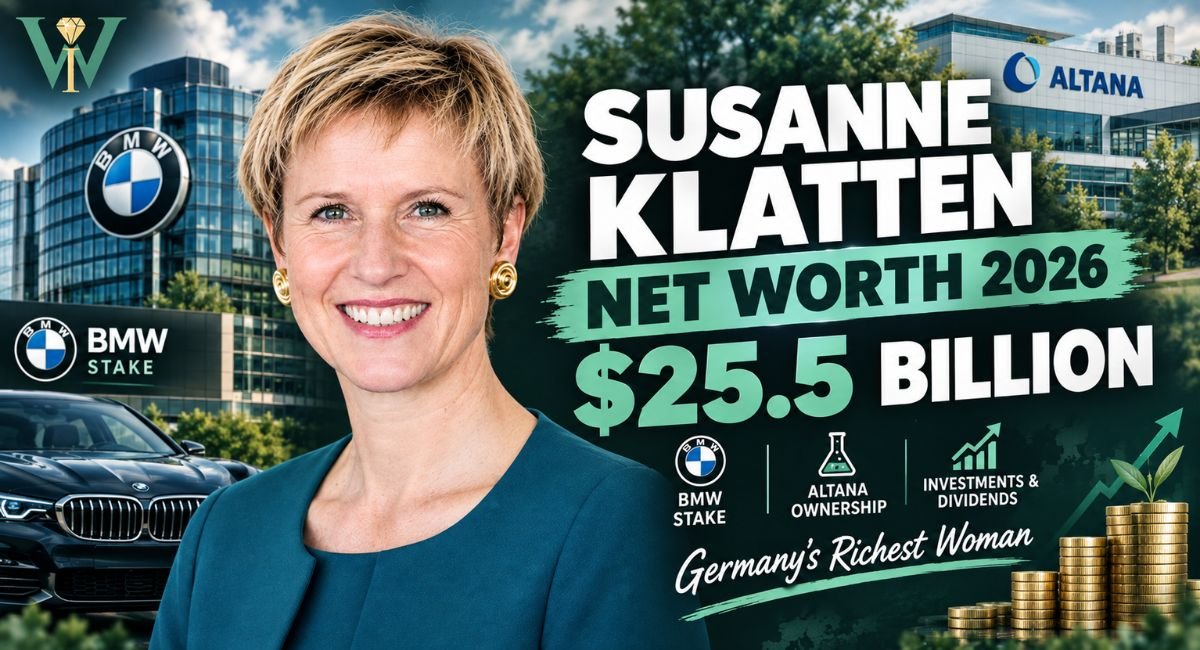
Susanne Klatten’s net worth is estimated at $25.5 billion as of September 5, 2026, according to Forbes’ real-time billionaire tracker. That figure is an estimate, not a confirmed or audited number, since Klatten’s core holdings include a privately held company that isn’t required to disclose a market value. Bloomberg’s own index, using a different valuation method, has recently put her fortune well above that mark. Either way, Susanne Klatten remains the richest woman in Germany, and her fortune rests almost entirely on two things: a large stake in BMW and outright ownership of the specialty chemicals company Altana AG.
This guide breaks down exactly where that money comes from, why the two most-cited estimates disagree, how much she likely earns each year in dividends, and what changed in 2024 and 2026 that most coverage of her wealth still hasn’t caught up with.
Quick Facts
| Full name | Susanne Hanna Ursula Klatten (née Quandt) |
| Net worth | $25.5 billion (estimated) |
| Net worth date | September 5, 2026 |
| Source of estimate | Forbes real-time billionaires list |
| Global rank | #101 as of September 5, 2026; #79 on Forbes’ 2026 Billionaires List |
| Born | April 28, 1962, in Bad Homburg, West Germany |
| Age | 64 |
| Nationality | German |
| Profession | Businesswoman, investor, corporate board member |
| Education | Bachelor’s in business administration, University of Buckingham; MBA, IMD Business School, Lausanne |
| Parents | Herbert Quandt (1910 to 1982); Johanna Quandt (1926 to 2015) |
| Siblings | Stefan Quandt (brother); Silvia Quandt (half-sister) |
| Spouse | Jan Klatten (married 1990, separated 2018) |
| Children | 3 (Felix, Alexander, Johanna) |
| Main wealth sources | BMW AG shares; 100% ownership of Altana AG; investment holding company SKion GmbH |
| Other holdings | SGL Carbon SE (28.55% via SKion), Entrust Corp (40%) |
| Known for | Richest woman in Germany; BMW supervisory board member; founder of UnternehmerTUM |
| Residence | Germany |
Susanne Klatten’s Net Worth: What the Numbers Actually Say
There is no single official figure for Susanne Klatten’s net worth, and any article that presents one flat number without a date is already out of date. Two major trackers publish independent estimates, and they currently disagree by a wide margin.
Forbes put her real-time net worth at $25.5 billion as of September 5, 2026, ranking her #101 in the world that day. Forbes’ most recent published Billionaires List, dated March 10, 2026, placed her at #79 globally.
Bloomberg’s Billionaires Index uses a different approach and has recently valued her fortune considerably higher. As of early September 2026, Bloomberg reported a year-to-date change of negative 8.9 percent for her, alongside a daily gain of $349 million. A separate industry ranking citing Bloomberg-style data put her fortune at roughly $31.1 billion in January 2026. The exact current Bloomberg figure isn’t independently confirmable here, since Bloomberg restricts automated access to its billionaire profile pages, but the direction and scale of these numbers point to a fortune meaningfully above Forbes’ figure.
Why the gap? Bloomberg has stated that it values her stake in Altana, which is privately held and not publicly traded, using the company’s most recent financials alongside valuation multiples from three comparable publicly traded chemical companies. Forbes uses its own private-company valuation methodology. Because BMW is publicly traded, both trackers can price that portion of her wealth almost identically. The disagreement is almost entirely about how much a fully private, unlisted chemicals conglomerate like Altana is worth on paper.
One more thing worth flagging: a widely repeated figure of $23.4 billion, sourced to Wikipedia and dated January 2022, still circulates across dozens of secondary sites in 2026. That number is roughly four years old and understates her current fortune by a wide margin. If you see it quoted as her “current” net worth anywhere, treat it as stale.
Net Worth by Year (Reported Estimates)
| Year | Estimated net worth | Source |
| 2019 | $19 billion | TheRichest |
| 2020 | $16.8 billion | Forbes (cited via Paycheck.in) |
| 2021 | $27.7 billion | Forbes (cited via Paycheck.in) |
| January 2022 | $23.4 billion | Bloomberg Billionaires Index (via Wikipedia) |
| 2024 | $26.5 billion | Forbes-derived estimate |
| 2025 | $28.5 billion | Reported estimate |
| August 2026 | $24.8 billion | WealthRank |
| September 5, 2026 | $25.5 billion | Forbes |
These year-over-year swings are not annual “income.” They reflect changes in BMW’s stock price, shifting valuation multiples for Altana, and currency movements, since her wealth is measured largely in euros but reported in dollars.
Where Her Money Comes From
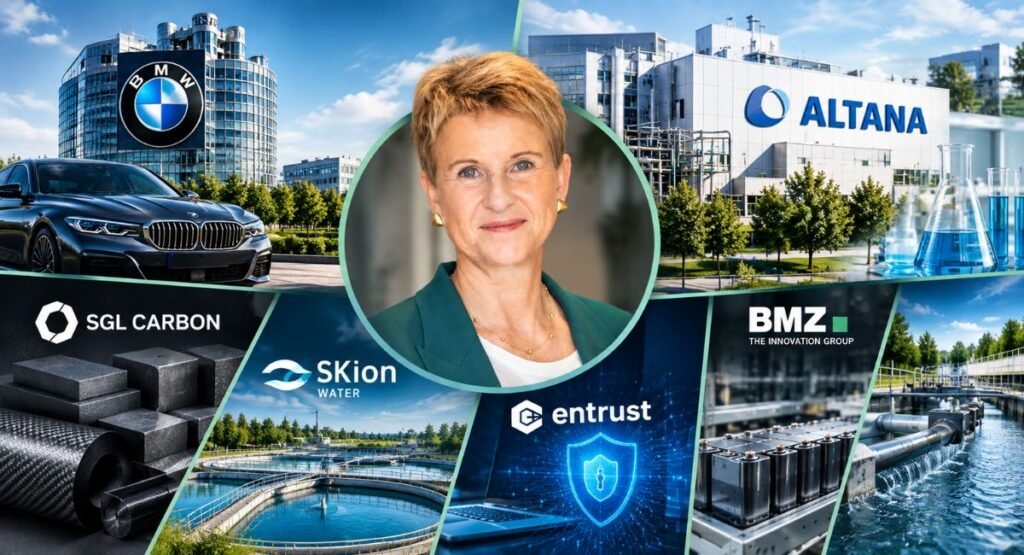
Klatten’s fortune is built on ownership, not a paycheck. She holds significant stakes in a handful of companies rather than drawing a traditional salary, and the value of her fortune moves with the fortunes of those businesses.
BMW AG
BMW is the single largest and most visible piece of Klatten’s wealth. According to Bloomberg, citing BMW’s 2025 annual report, she holds a 0.2 percent stake directly and an additional 22.3 percent through a holding vehicle called Susanne Klatten Beteiligungs GmbH. Other outlets, including Forbes and Wikipedia, have described her stake as closer to 19 percent, and German financial media has cited a direct holding of 21.7 percent.
These figures are not necessarily contradictory. Until mid-2026, BMW’s share capital was split between voting ordinary shares and non-voting preferred shares. A stake expressed as a share of all outstanding capital (ordinary plus preferred) naturally looks smaller than a stake expressed as a share of ordinary, voting capital alone. Different outlets have historically used different bases, which explains most of the spread you’ll see reported.
That distinction became more complicated in 2026. On May 13, 2026, BMW’s shareholders approved converting all preferred shares into ordinary shares. The conversion was formally registered on June 30, 2026, and that date marked the final day preferred shares traded separately, according to BMW’s own investor relations disclosures. As a result, BMW’s old two-class share structure no longer exists, and a precise, source-confirmed percentage for Klatten’s post-conversion stake in the unified share class was not available at the time of writing. Her next confirmed figure will likely come from BMW’s 2026 annual report or a future voting-rights notification.
Together, Klatten and her brother, Stefan Quandt, control roughly 46 to 47 percent of BMW, a position the family has held since inheriting it from their father, Herbert Quandt, in 1982.
Altana AG
Altana is a specialty chemicals company headquartered in Wesel, Germany, and Klatten owns 100 percent of it through her investment company, SKion GmbH. Unlike BMW, Altana has no public shareholders and no public stock price, which is exactly why the two major billionaire indexes disagree over its value.
Altana is a real, operating business with genuine scale. In fiscal year 2025, the company reported sales of about 3.08 billion euros, essentially flat with the prior year’s 3.17 billion euros in nominal terms, though up 1 percent on an operating basis once currency effects were stripped out. Earnings before interest, taxes, depreciation, and amortization rose 7 percent to 523 million euros, and the company spent 216 million euros, or about 7 percent of sales, on research and development, a record for the company. Altana employs more than 8,000 people. In the first half of 2026, sales rose again to 1.675 billion euros, up 3 percent year over year.
It’s worth being precise here: Altana’s 3.08 billion euros in sales is company revenue, not Klatten’s personal income and not a direct measure of her net worth. Revenue reflects money flowing through the business; her net worth reflects the estimated value of her ownership stake in that business, which analysts calculate very differently and which can rise or fall independent of any single year’s sales figure.
SKion GmbH and the Rest of the Portfolio
SKion is Klatten’s private investment holding company, founded in 2006 out of the proceeds of Altana’s sale of its pharmaceutical division to Nycomed for 4.5 billion euros. Through SKion, Klatten (and now her children, more on that below) hold stakes in several other companies:
- SGL Carbon SE, a graphite and carbon products maker: SKion holds 28.55 percent, according to a 2024 company filing, with Bloomberg citing a similar 29 percent figure from SGL’s 2025 annual report. Klatten chaired SGL Carbon’s supervisory board from 2013 until 2023.
- Entrust Corp, a digital identity and security company: Bloomberg reports a 40 percent stake.
- SKion Water, a water technology investment arm, with holdings including EnviroChemie and full ownership of Paques Technology B.V.
- BMZ Group, a lithium-ion battery manufacturer, in which SKion holds a 20 percent stake and took over insolvent subsidiaries in December 2025.
One holding that regularly appears in older articles but is no longer accurate is Nordex SE, a wind turbine manufacturer. SKion first invested in Nordex in 2008 and sold most of that stake to Acciona in 2015. On January 29, 2026, SKion sold its entire remaining position, about 7 million shares, or roughly 2.96 percent of Nordex’s share capital, to institutional investors at 32.15 euros per share, a transaction worth close to 225 million euros. Any current source still listing Nordex as one of Klatten’s holdings is out of date.
How Much Does Susanne Klatten Actually Earn?
Net worth measures the estimated value of what someone owns. Income measures what flows to them each year. For a major shareholder like Klatten, the clearest, most calculable form of income is dividends, and BMW’s dividend history makes it possible to build a reasonable estimate.
BMW’s dividend per ordinary share over the past several years:
| Fiscal year | Dividend per ordinary share |
| 2020 | €1.90 |
| 2021 | €5.80 |
| 2022 | €8.50 |
| 2023 | €6.00 |
| 2024 | €4.30 |
| 2025 | €4.40 |
The 2025 dividend of €4.40 per share was approved at BMW’s annual general meeting on May 13, 2026, and paid out on May 19, 2026, across 550,129,337 dividend-bearing ordinary shares.
Using Bloomberg’s reported stake of roughly 22.5 percent of BMW’s ordinary shares (the 0.2 percent direct holding plus the 22.3 percent held through Susanne Klatten Beteiligungs), that works out to approximately 123.8 million shares. At €4.40 per share, that implies a dividend payment of roughly €545 million, or about $590 million at recent exchange rates, before any German withholding tax. This is our own calculation based on public figures, not a number reported by BMW or by Klatten herself, so treat it as an informed estimate rather than a confirmed figure.
That estimate lines up reasonably well with past reporting. German business newspaper Handelsblatt reported that Klatten received 504 million euros in 2017 based on a 20.9 percent stake, a similar order of magnitude adjusted for her slightly larger current holding and that year’s dividend rate.
It’s worth separating the terms clearly, since they’re often blurred together in casual coverage:
- Net worth is the estimated value of everything she owns, minus debts. It’s a snapshot, not cash in hand.
- Dividend income is the actual cash BMW pays her each year as a shareholder. It’s real, recurring, and taxable.
- Company revenue (like Altana’s 3.08 billion euros in 2025 sales) belongs to the company, not to her personally, though it does influence how much Altana is worth and therefore how much her ownership stake is worth.
- Company valuation or enterprise value is a separate estimate of what an entire business is worth, which then gets divided by ownership percentage to estimate an individual’s stake.
The 2024 Handover of SKion to Her Children
One of the least-covered developments in Klatten’s financial story is a quiet but significant ownership restructuring that began in 2024.
In June 2024, Klatten announced she was transferring ownership of SKion GmbH, her main investment holding company, to her three children: Felix, Alexander, and Johanna. According to reporting at the time, SKion’s 50 million euros in share capital had to be increased by one euro so it could be split evenly three ways, since 50 million doesn’t divide cleanly by three. Each child reportedly received ordinary shares worth 16,666,666 euros through individual holding entities named SKion Primus, Secundus, and Tertia. Klatten retained a small residual holding and, under SKion’s articles of association, reportedly kept the right to unilaterally appoint certain positions. She also remained SKion’s managing director, describing the move in an interview as “not a classic handover, it’s more a transition.”
The clearest public confirmation of this change came from SGL Carbon. On June 25, 2024, the company published a formal voting-rights clarification stating that voting rights in SGL Carbon held through SKion were no longer attributable to Klatten personally, because she no longer controlled SKion. SKion itself remained SGL Carbon’s largest shareholder, at 28.55 percent, but the person legally in control of that stake had changed.
This matters because it raises a real question that current wealth trackers don’t clearly answer: if legal control of Altana, SGL Carbon, and the rest of the SKion portfolio has shifted to her three children, how much of the “$25 billion to $31 billion” figure attributed to Susanne Klatten personally still belongs to her, versus to the next generation? Her direct BMW stake, held outside SKion, was not part of this transfer and clearly remains hers. The SKion-held assets are a different story, and neither Forbes nor Bloomberg has made public exactly how they’re treating this distinction in their calculations. This is worth watching, since it may eventually split what is currently reported as a single fortune into four separate ones.
From Heiress to Operator: A Career Timeline
- 1981 to 1983: Works at advertising agency Young & Rubicam in Frankfurt after finishing school.
- 1982: Her father, Herbert Quandt, dies. She inherits a stake in BMW (reported at around 12.5 percent of that era’s share structure) and a 50.1 percent stake in Altana.
- Mid-1980s: Attends the University of Buckingham and later IMD Business School in Lausanne for her MBA. Interns at BMW under the name Susanne Kant to gain experience without her surname influencing how she was treated.
- 1990: Marries engineer Jan Klatten, whom she met during her time at BMW.
- 1996 to 1997: Joins BMW’s supervisory board alongside her brother, Stefan Quandt.
- 2002: Founds UnternehmerTUM, an entrepreneurship and startup center at the Technical University of Munich.
- 2006: Altana sells its pharmaceutical division to Nycomed for 4.5 billion euros, distributed to shareholders as a dividend. SKion GmbH is founded the same year using proceeds from the sale.
- 2008 to 2010: SKion acquires the remaining publicly held shares of Altana and takes the company fully private, ending its 33-year stock market listing.
- 2015: Her mother, Johanna Quandt, dies. Susanne’s BMW stake rises to roughly 19.2 percent of the company’s total share capital.
- 2016: Launches the SKala-Initiative to provide professional support to 100 nonprofit organizations across Germany.
- 2018: Separates from Jan Klatten.
- June 2024: Begins transferring ownership of SKion GmbH to her three children.
- January 29, 2026: SKion sells its entire remaining stake in Nordex SE.
- May to June 2026: BMW shareholders approve, then complete, the conversion of preferred shares into ordinary shares, ending the company’s two-class share structure.
Family, Education, and Personal Life
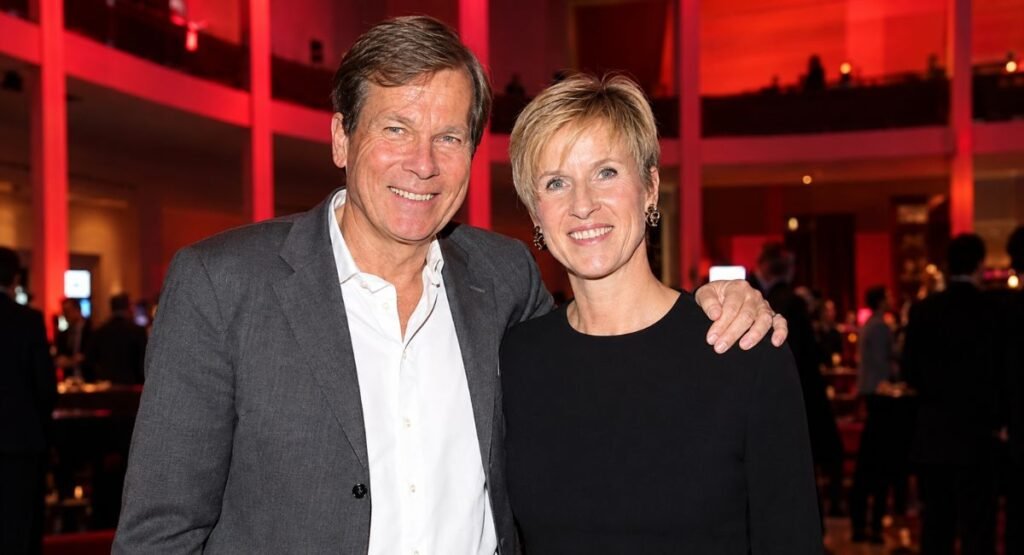
Susanne Klatten was born Susanne Hanna Ursula Quandt on April 28, 1962, in Bad Homburg, West Germany, the eldest child of industrialist Herbert Quandt and his third wife, Johanna Quandt. She has a full brother, Stefan Quandt, and a half-sister, Silvia Quandt, from her father’s earlier marriages.
She studied business administration at the University of Buckingham in England and later earned an MBA from IMD Business School in Lausanne, Switzerland. The University of Buckingham named her an honorary graduate in 2022.
She married engineer Jan Klatten in 1990 after meeting him during a traineeship at BMW’s plant in Regensburg. The couple had three children, Felix, Alexander, and Johanna, and separated in 2018. In 2007, Klatten became the target of an extortion scheme by Swiss businessman Helg Sgarbi, who defrauded her of roughly $10 million and threatened to release recordings unless she paid a much larger sum. She reported the scheme to authorities, and Sgarbi was convicted in 2009.
Philanthropy and Public Roles
Beyond her business holdings, Klatten has built a track record in entrepreneurship support and cultural philanthropy:
- UnternehmerTUM, founded in 2002, has grown into one of Germany’s largest centers for supporting startups and business creation, based at the Technical University of Munich, where Klatten chairs the supervisory board.
- The SKala-Initiative, launched in 2016, provides funding and organizational support to 100 nonprofit organizations across Germany.
- Stiftung Kunst und Natur (also associated with Stiftung Nantesbuch), a foundation she has supported since 2012 focused on art and nature.
- She has served on the University Council of the Technical University of Munich since 2005 and sits on the board of a charitable foundation named after her father.
- She has received Bavaria’s Order of Merit for her civic and business contributions.
The Quandt Family’s Nazi-Era History
Any complete account of Klatten’s family fortune needs to acknowledge where it originated. In 2007, a German television documentary called “The Silence of the Quandts” examined the family’s activities during the Nazi era. In response, several family members, including Stefan Quandt and his half-sister Gabriele Quandt, publicly committed to funding an independent historical investigation.
That study, conducted by Bonn historian Joachim Scholtyseck with what he described as unrestricted access to family and company archives, was published in 2011. It documented that Quandt family factories used more than 50,000 forced laborers, prisoners of war, and concentration camp prisoners between 1940 and 1945, many of whom worked under conditions that caused illness and death. The study also found that the family appropriated assets from Jewish business owners during the Nazi era’s forced “Aryanization” process. Herbert Quandt, Klatten’s father, joined the Nazi party in 1940 and served as personnel director at one of the family’s factories during the war. The study’s overall conclusion was that the Quandt family was inseparably linked to the crimes of the Nazi era. BMW itself, founded independently of the Quandt family’s wartime industrial operations, was not implicated in the report.
Susanne Klatten was born two decades after the war ended and bears no personal responsibility for these events. Her family’s decision to commission an independent historical study, and to make the underlying archives publicly accessible through the Hessian Economic Archive, is itself part of the public record and worth noting alongside the findings.
Susanne Klatten vs. Stefan Quandt
Klatten and her brother, Stefan Quandt, inherited their fortunes from the same source and have since built distinct business empires around the same core BMW stake.
| Susanne Klatten | Stefan Quandt | |
| BMW stake | Roughly 19% to 22% (pre-2026 structure); exact post-conversion figure not yet confirmed | Roughly 24% |
| Holding company | SKion GmbH | Delton AG and AQTON SE |
| Other major holdings | Altana (100%), SGL Carbon (28.55%), Entrust (40%) | Logistics, medical technology, and renewable energy investments |
| Combined family BMW control | Approximately 46% to 47% between them |
Both siblings sit on BMW’s supervisory board, a position they’ve held jointly since the mid-1990s, and both run independent family offices rather than managing a shared fortune.
Conclusion
Susanne Klatten’s fortune is easier to understand once you separate the pieces: a large, publicly priced stake in BMW; full, privately valued ownership of Altana; a portfolio of smaller holdings run through SKion; and, since 2024, a family succession process that has started moving some of that ownership to the next generation. The $25.5 billion figure from Forbes and the higher estimate implied by Bloomberg’s methodology aren’t really in conflict, they’re measuring the same assets with different assumptions about what a private chemicals company is worth. What’s clear across every credible source is that she remains, by a wide margin, the wealthiest woman in Germany, and that her wealth continues to be driven almost entirely by decisions made decades ago by her father, refined over 40 years of active board involvement rather than passive inheritance.
Frequently Asked Questions
Forbes estimated her net worth at $25.5 billion as of September 5, 2026. This is an estimate based on her stake in publicly traded BMW and a private valuation of her fully owned company, Altana, not an audited or confirmed figure.
Yes. Across every major ranking, including Forbes and Bloomberg, she consistently ranks as Germany’s wealthiest woman, a position she has held for more than a decade.
Both. She inherited a stake in BMW and a majority stake in Altana after her father, Herbert Quandt, died in 1982. She then took an active role managing Altana, transforming it from a smaller pharmaceutical and chemicals business into a global specialty chemicals company with more than 3 billion euros in annual sales, and has sat on BMW’s supervisory board for roughly three decades.
Reported figures vary because of how BMW’s share structure worked before mid-2026. Bloomberg, citing BMW’s 2025 annual report, put her combined direct and indirect stake at around 22.5 percent of ordinary shares. Other sources cite figures closer to 19 percent based on total outstanding capital including now-converted preferred shares. Her exact stake following BMW’s June 2026 conversion of preferred shares into ordinary shares has not yet been confirmed by a primary source.
SKion is Susanne Klatten’s private investment holding company, founded in 2006. It holds her ownership of Altana AG and stakes in companies including SGL Carbon, Entrust, and several water technology and battery businesses. In 2024, she began transferring ownership of SKion to her three children.
No. SKion, her investment company, sold its entire remaining stake in the wind turbine manufacturer Nordex on January 29, 2026, ending an investment that dated back to 2008.
There’s no confirmed public salary figure, since she doesn’t hold a traditional job. Based on BMW’s 2025 dividend of 4.40 euros per share and her reported shareholding, her annual BMW dividend alone is estimated at roughly 545 million euros, though this is a calculation based on public data rather than a figure she or BMW has disclosed directly.
She married engineer Jan Klatten in 1990 and the couple separated in 2018. They have three children together.
She owns 100 percent of Altana AG through SKion, holds a major stake in BMW AG, and controls significant positions in SGL Carbon SE and Entrust Corp, along with smaller holdings in water technology and battery manufacturing companies.
Sources and Methodology
This article relies on primary financial disclosures and established financial media wherever possible, cross-checked for dates and figures.
- Forbes, real-time billionaire profile and 2026 Billionaires List, for net worth estimates and ranking.
- Bloomberg Billionaires Index, for net worth methodology, ownership percentages, and year-to-date change figures.
- BMW Group investor relations disclosures, including dividend history, the 2026 annual general meeting resolution, and the preferred-to-ordinary share conversion timeline.
- Altana AG company press releases, for fiscal year 2025 and first-half 2026 sales, EBITDA, and R&D figures.
- SGL Carbon SE official voting-rights disclosure, dated June 25, 2024, confirming the transfer of SKion control.
- Handelsblatt and Reuters, for reporting on the January 2026 Nordex share sale and the 2024 SKion succession.
- Wikipedia, for biographical details including education, family relationships, and career timeline, cross-referenced against other sources.
- Historical background on the Quandt family draws on the 2011 Scholtyseck study and subsequent reporting by outlets including the Financial Advisor and the Daily Herald.
Figures described as estimated reflect third-party valuations of privately held or illiquid assets and can change significantly with stock prices, currency movements, and shifts in private-company valuation multiples. Where sources disagreed, this article notes the discrepancy rather than presenting a single number as definitive.

Tanzeela is a writer and researcher at WorthIcons, covering celebrity net worth, business, careers, wealth, and biographical stories. She researches publicly available information from reputable sources and aims to present financial estimates clearly and responsibly.