
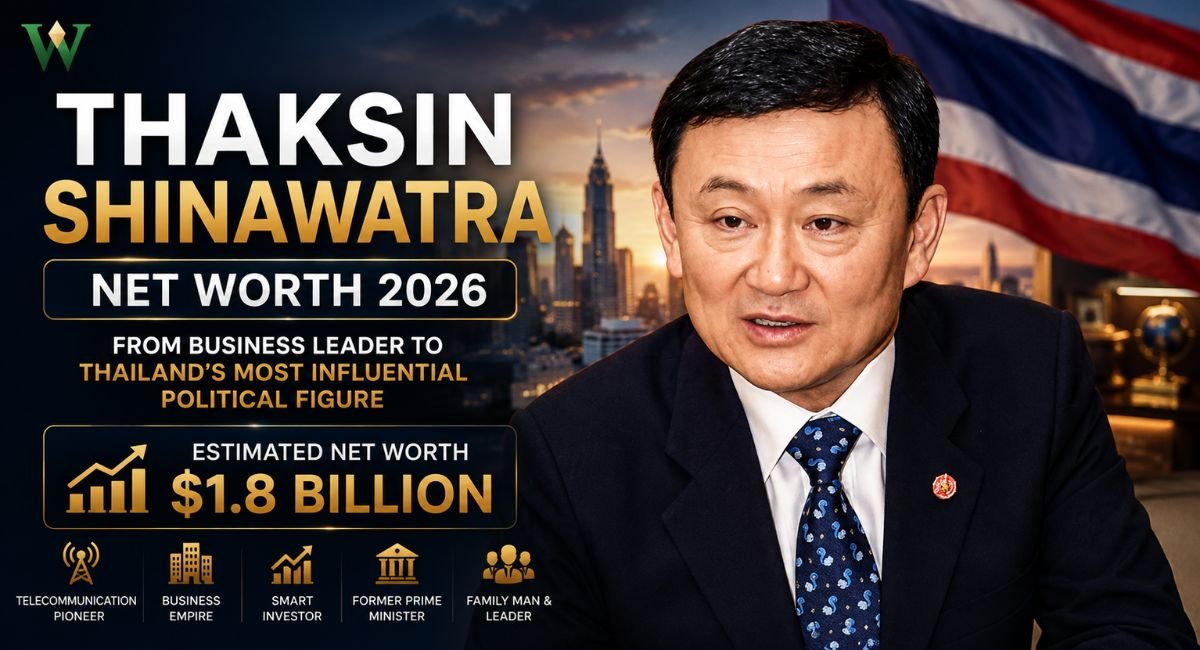
Thaksin Shinawatra is one of Thailand’s most recognizable businessmen and political figures, with a remarkable journey from policing to telecommunications and politics. His success in business helped build a substantial fortune before his political career made him internationally known. Thaksin Shinawatra net worth has remained closely connected to his investments, corporate interests, and valuable assets accumulated over several decades.
His business empire expanded through telecommunications, real estate, healthcare, and other ventures, creating multiple sources of wealth. Beyond money, his career has shaped Thailand’s modern political landscape and influenced his family’s public profile. This article explores his wealth, investments, career, family background, properties, and political legacy in detail.
Thaksin Shinawatra Net Worth and Wealth Breakdown
The clearest starting point for understanding Thaksin Shinawatra net worth is his investment portfolio. Forbes currently estimates his wealth at roughly $1.8 billion. That figure represents estimated assets minus relevant liabilities rather than money sitting in a bank account.
His fortune originally grew through telecommunications before expanding into property, healthcare, and other investments. Forbes says he owns a controlling stake in SC Asset and has invested in U.K. health-tech companies. His financial position therefore looks more diversified today than it did during his telecommunications heyday.
| Wealth Factor | 2026 Information |
| Estimated net worth | About $1.8 billion |
| Main wealth source | Investments |
| Citizenship | Thailand |
| Age | 77 |
| Major property interest | SC Asset |
| Major historic company | Shin Corporation |
| Children | 3 |
| Residence listed by Forbes | Bangkok |
The estimate can move as market prices change. That matters because a billionaire can gain or lose millions without selling anything. Forbes’ real-time profile showed Thaksin at about $1.8 billion in early September 2026.
Early Life, Education and Family Background
The roots of the Thaksin Shinawatra biography reach back to Chiang Mai, where he was born in 1949. He grew up in a prominent family with Chinese-Thai roots. His family’s commercial background exposed him to business at an early age.
Education later opened another door. Thaksin studied at the Armed Forces Academies Preparatory School before joining the police. He eventually earned a master’s degree from Eastern Kentucky University. That combination of education, public service, and technology experience shaped his unusual path into business and politics.
His family also became important to his later financial and political story. Thaksin married Potjaman Damapong, and the couple had three children. Their family network later became associated with several major Thai companies and political movements.
Thaksin Shinawatra’s Early Career and Business Ventures
Before becoming a major businessman, Thaksin spent years in Thailand’s police service. His professional background may seem distant from technology. However, his interest in computers and communications eventually redirected his entire career.
His early career in technology included ventures involving computer equipment and related services. The road wasn’t perfectly smooth. Several early commercial efforts struggled before he found a business model with enormous growth potential. Telecommunications eventually provided that breakthrough.
Thaksin understood something important. Thailand’s communications market was expanding rapidly, and mobile phones could become a mass-market service. He moved toward that opportunity instead of staying tied to his earlier ventures.
That decision became the beginning of his business empire. Rather than building wealth through one traditional industry, he focused on scalable technology. The strategy allowed his companies to reach millions of customers and created a powerful financial base.
Building a Telecommunications Empire With Shin Corporation

The defining chapter of Thaksin’s business story was Shin Corporation. The group expanded across telecommunications and technology as Thailand’s mobile market accelerated. Advanced Info Service, commonly known as AIS, became one of the country’s leading mobile operators.
The growth of mobile communications transformed his telecommunications empire. More subscribers meant recurring revenue and rising corporate value. Thaksin’s companies benefited from this structural change as mobile phones shifted from expensive status symbols toward everyday necessities.
The eventual sale of Shin Corporation became a major turning point. In 2006, Thaksin’s family sold its controlling stake to Singapore’s Temasek for about $1.9 billion. The transaction generated enormous political controversy because Thaksin was prime minister at the time.
The deal also became central to debates about tax, conflicts of interest, and political power. In 2017, Thailand’s military government imposed a retrospective tax connected to the sale of his Shin Corp shares. Forbes later reported a separate 17.6 billion baht tax demand in 2025.
Thaksin Shinawatra’s Entry Into Politics and Rise to Power
Business success gave Thaksin enormous resources and visibility. Politics offered a different kind of influence. He entered national politics during the 1990s before founding the Thai Rak Thai Party in 1998.
His political career gained momentum because he offered policies aimed at ordinary households. Healthcare, rural development, and economic support became central themes. He presented himself as a practical political leader who could manage government with the discipline of a company executive.
The 2001 election proved decisive. Thai Rak Thai won a historic victory, and Thaksin became prime minister. His party then secured another major election victory in 2005. Reuters describes him as a leader whose policies won strong support among Thailand’s rural poor.
His rise also changed the balance of Thai politics. Wealth, mass campaigning, policy promises, and strong party organization created a new political formula. Supporters saw modernization and economic opportunity. Critics saw growing concentration of political influence.
Thaksin Shinawatra as Prime Minister of Thailand
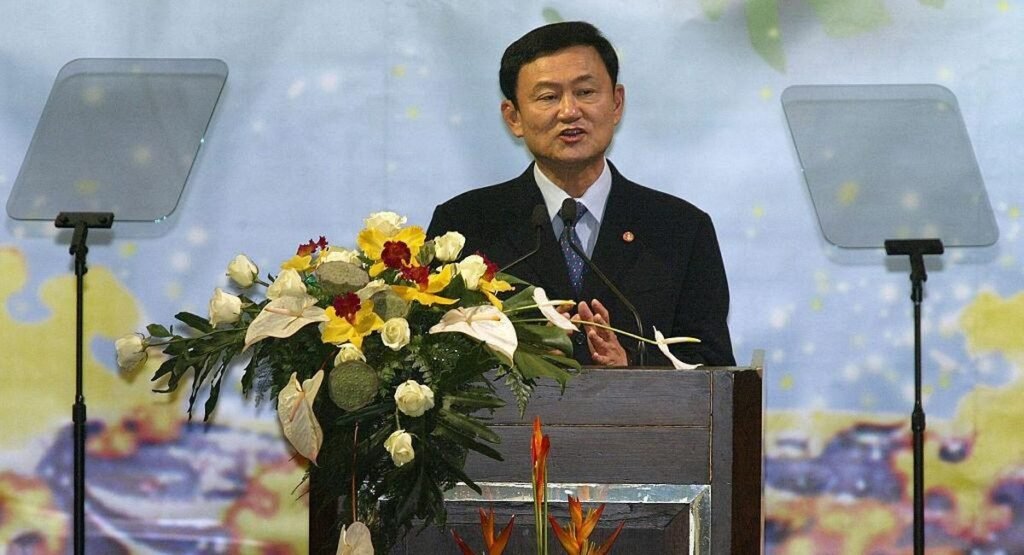
Thaksin’s time as Prime Minister remains one of the most consequential periods in modern Thai politics. His government introduced policies that directly affected millions of people. Universal healthcare became especially famous because it expanded access to medical treatment for large sections of the population.
His government also promoted rural development, debt relief, and economic stimulus measures. These economic policies helped strengthen his popularity outside Bangkok. For many supporters, Thaksin represented a government that finally paid attention to ordinary citizens.
However, the administration faced serious criticism. Opponents accused Thaksin of weakening institutional checks and concentrating power. His government also faced human-rights criticism over its war on drugs.
This tension explains why opinions about Thaksin remain sharply divided. To supporters, he was a reform-minded leader who changed government priorities. To opponents, his growing power created dangerous conflicts between politics, business, and state institutions.
Coup, Exile, Legal Battles and Frozen Assets
Thaksin’s political dominance eventually collapsed. In September 2006, the military staged a coup while he was abroad. He did not return to Thailand immediately and spent years outside the country.
His long exile became another major chapter in his story. During this period, he remained politically active and supported parties linked to his movement. Reuters notes that parties supported by Thaksin continued winning elections during his years abroad.
Legal problems followed him throughout this period. Thai courts convicted him in cases involving abuse of power and other offenses. His supporters argued that several proceedings were politically motivated. The disputes also affected his assets and broader financial position.
In September 2025, Thailand’s Supreme Court ordered him to serve one year in prison. Two months later, authorities imposed a 17.6 billion baht tax demand connected to his earlier Shin Corp transaction.
These legal battles show why calculating his wealth requires caution. Court orders, taxes, corporate ownership, and family holdings can affect the amount that actually belongs to him personally.
Thaksin Shinawatra’s Businesses, Investments, Properties and Assets
Today, Thaksin Shinawatra investments extend beyond the telecommunications sector. Forbes identifies SC Asset as one of his important corporate interests. The company operates in Thailand’s property market and gives his portfolio exposure to real estate.
His connection with SC Asset Corporation is especially significant because property can provide recurring business value and long-term capital appreciation. Yet readers should distinguish between company value and personal wealth. Owning shares in a company isn’t the same as personally owning every property that company controls.
Healthcare is another part of the wider financial picture. Praram 9 Hospital is a listed Thai healthcare company. Its shareholder records show that Potjaman Damapong was the largest shareholder as of May 5, 2026, while Thaksin’s three children each held 5 million shares.
The Stock Exchange of Thailand reported Praram 9 Hospital’s market capitalization at about 14.6 billion baht on September 2, 2026. That figure describes the company as a whole, not Thaksin’s personal stock holdings.
Forbes also reports that Thaksin invested in two U.K.-based health technology startups, DNANudge and Owlstone Medical. These ventures show how his financial interests have moved beyond his original telecommunications base.
Thaksin Shinawatra’s Family, Children and Political Legacy

The Thaksin Shinawatra family has played an unusually large role in Thailand’s public life. His three children are Panthongtae, Pintongta, and Paetongtarn Shinawatra. Family members have also appeared in corporate shareholder records, showing the broader financial reach of the family network.
His wife, Potjaman Damapong, became an important figure in the family’s financial story. She has held major corporate interests, including a substantial position in Praram 9 Hospital. This makes it important not to treat every family asset as part of Thaksin’s personal wealth.
The political story is even more striking. Thaksin’s sister Yingluck Shinawatra became prime minister. His daughter Paetongtarn Shinawatra later became prime minister in 2024 before leaving office in 2025.
That continuity illustrates the strength of his political legacy. Few Thai political families have maintained such influence across multiple generations. Even when Thaksin himself wasn’t holding office, his name remained deeply connected with Thailand’s political landscape.
Thaksin Shinawatra’s Return to Thailand and Current Influence
After about 15 years abroad, Thaksin returned to Thailand on August 22, 2023. Authorities detained him after his arrival because of outstanding convictions. He was later released on parole after serving part of his sentence.
His return marked a dramatic shift. The former prime minister was physically back in Thailand after years of living abroad. Yet his legal troubles weren’t finished. In September 2025, the Supreme Court ordered him to serve one year over previous convictions.
By May 2026, Forbes reported that Thaksin had been released from jail after serving eight months. His release did not erase his wider significance. His family continued to command attention, while his political opinions remained influential in national debates.
So, where does Thaksin Shinawatra net worth stand now? Forbes places it around $1.8 billion. His financial story is no longer simply about telecommunications. It now reflects decades of entrepreneurship, property interests, healthcare connections, private investments, and the complicated legacy of Thailand’s most controversial billionaire politicians.
Conclusion
Thaksin Shinawatra’s journey from a police officer and businessman to one of Thailand’s most influential political figures is remarkable. His net worth has been built through telecommunications, investments, real estate, and other business interests developed over several decades. His success with Shin Corporation played a major role in creating his fortune, while his political career significantly increased his public influence.
Today, Thaksin remains an important figure in Thailand’s political and business landscape. His family continues to have interests across business and politics, while his own career has been shaped by both major achievements and serious legal and political challenges. Although estimates of his wealth and assets can change with market conditions and legal developments, his impact on Thailand’s modern political and economic history remains substantial.
Frequently Asked Questions About Thaksin Shinawatra
Thaksin Shinawatra’s estimated net worth is around $1.8 billion in 2026, according to Forbes.
Thaksin is currently in Thailand. He returned to the country in 2023 and was released from prison in May 2026 after serving eight months
Yes. The Shinawatra family has Chinese Hakka ancestry, with their roots tracing back to Guangdong, China.
Thaksin left Thailand after the 2006 military coup removed him from power. He later lived in self-imposed exile for about 15 years while facing legal cases in Thailand.
“Thaksin” (ทักษิณ) is a Thai word associated with the south or southern direction. It comes from the Sanskrit-derived term dakṣiṇa.

Tanzeela is a writer and researcher at WorthIcons, covering celebrity net worth, business, careers, wealth, and biographical stories. She researches publicly available information from reputable sources and aims to present financial estimates clearly and responsibly.